Monday, April 15, 2019

Why Does Emmy Serve At The Pleasure of This President: Veep Final Season Review


Why Does Emmy Serve At The Pleasure of This President?
A Look Back at Veep

I’ve always had extremely mixed feelings about HBO’s comedy powerhouse Veep. Now, I’ll admit that when I watched it at its peak – between Season 3 and Season 5 – I thought that it could often be hysterically, profanely funny. I had on my top ten list for two years. But the more toxic our current political situation has become – and Veep as both mirror and pioneer in that regard – the sadder and more ashamed I become of liking it.
And I guess my major problem with is Selina Meyer. Now, I love Julia-Louis Dreyfus. I think she is a national treasure going back to her work on Saturday Night Live in the mid 1980s. I’ve even elevated my thinking on Seinfeld largely because of her work as the iconic character of Elaine. But the longer I have seen her work as Selina, the more I can’t understand the point of her character. Is it to prove that woman politicians are just as clueless, unthinking and foul-mouthed as the male ones? That’s not particularly encouraging. A worse sign is that she approaches politics in  a way that I find truly frightening. However ruthless and immoral the world of politics was in Scandal and House of Cards, you could at least sometimes see that the people at the top of the food chain wanted to do something with their power was they had it. Selina has no clear message, has never had anything near an idea for governing, or even a reason to run for President in the first place. She just wants to be a politician because she can’t think of anything else to do.

Julia Louis-Dreyfus, Anna Chlumsky, Gary Cole, Kevin Dunn, Tony Hale, Matt Walsh, Reid Scott, Sam Richardson, and Timothy Simons in Veep (2012)
And that level of cluelessness, once hysterically funny, has gotten less and less charming the longer the series has been on the air. Jonah Ryan, who seems to consistently fail upward, is so moronic and foolish a character that we can’t even feel sorry for him when he gets molested by a presidential aide or develops testicular cancer. This is a man, who as a Congressman, basically shut down the government because he wasn’t invited to an unveiling of a portrait, even though didn’t understand what an unveiling was. Now, he seems to be running for President, and he just seems to have no idea what he’s doing is wrong. Just in the past three episodes, he’s married his equally clueless stepsister, created a social movement where women are banding together to say they haven’t been sexually harassed by him, and  was so insensitive in public that he underwent sensitivity training and was so offensive the trainers sued him.
And there is generally the sensation that any subject – no matter how politically explosive – is subject to foul-mouthed jokes. Never was that more clear in last nights episode where Amy (Anna Chlumsky) Selina’s top aide, tormented by her own accidental pregnancy with occasional lover Dan (Reid Scott), decided to get an abortion. And everything about was handled foully. From Selina’s response to ‘dock that fatty a day’s pay’ – to Amy’s cursing out protester outside a clinic – to Dan’s handing her a tampon model that he’s used for similar occasions. Now, I’m all for satirizing the seemingly unmockable, but this just seems like the writers have decided that this is their bucket list and their going to offend as many as people as possible before the lights are turned out.
Veep’s general level of acclaim has always seemed accented by the Emmys, which I regard more to the voters laziness than any real consistency. Julia-Louis Dreyfus did not deserve six consecutive Best Actress Emmys any more than Helen Hunt did in the 1990s or  Doris Roberts did in the early 2000s. And compared to some of the other truly great female performers in the last decade, it doesn’t even rate a comparison. I’m thinking particularly of Amy Poehler as Leslie Knope on Parks and Recreation, a series which was just as cynical about politics as Veep is but infinitely more optimistic. That Poehler lost repeatedly to Dreyfus (and that the series as a whole struggled to get nominations that Veep got by divine right) is one of the great injustices in the history of an awards shows that is profligate in them.  Nor is she the only loser – Tracee Ellis Ross and Amy Schumer have been shutout by her, and incredible talents like Rachel Bloom and Gina Rodriguez have been denied nominations partially due to the Emmys habit of nominating her year after year. And the other series Veep has beaten for Best Comedy – black-ish and Atlanta in particular come to mind – are groundbreaking in ways Veep doesn’t even come close to coming near to.
That isn’t to say there aren’t a few pleasures in this series. Kevin Dunn and Gary Cole have been superb as Selina’s world-weary aides, and in the last few years Sam Richardson steals every scene he’s in as Richard, one of the few cheerful people in the entire series. And there’s one model of consistency, Tony Hale’s magnificent performance as Gary, Selina never-complaining, loyal to his own detriment body-man, who is the series doormat and makes me laugh with every line he says. He has deserved both the Emmys he received for this series.
But as Selina Meyer’s final quest for the Presidency reaches its end this year, I feel even wearier watching her go through the process than an actual presidential primary campaign. Will Selina win the White House again? At this point, I really am finding it hard to care.  The politicos on this series will constantly say they’re tired of politics as usual, but the more I watch the more I long for the simpler, rosier walk-and-talks of The West Wing. At least, they believed in what they were doing. The people who walk the corridors of power in Veep don’t even believe in themselves.
My score (collectively): 2.25 stars.

Saturday, April 13, 2019

Deadwood Episode Guide: Sold Under Sin


Written by Ted Man
Directed by Davis Guggenheim

The season finales of any series – at least in the new Golden Age – generally bring to a climax the overriding plots of the season, as well as bringing in new wrinkles for the future. In its inaugural season, Deadwood does so by bringing in history in a way in so many other series.
Early in the episode, General Crook (the distinguished character actor Peter Coyote) rides into town with his cavalry shortly after defeating Miniconjou Sioux at the Battle of Slim Buttes. (Fitting into the calendar, this means were in late September or early October of 1876. Swearengen seems to sense that they are coming, and while he’s more concerned with the return of Magistrate Clagget, who not only seems to have avoided Adams but now has the military’s protection, he knows enough of his duties to say: “Town’s gonna wanna parade.” The weary Crook arranges for this to happen, and when the cavalry marches into town, he gives a speech which, in true Deadwood tradition gives lie to history. As he gives the ‘historic’ version of events, a soldier mentions in sotto voice to Bullock what has actually happened:
Crook: The Sioux and Cheyenne, having burned the prairie to deny us fodder for our mounts. Our provisions limited to what we could carry. We turned to the Black Hills when the rains began
Soldier: Where my bay mare Sheridan she foundered and he had her shot.
Crook: That march through mud was a trial sent by God. And harsh necessity required of us much suffering and great sacrifice.
Soldier: Ate our fuckin’ horses.
Crook: Continuing south we proved our worth against the Indian. We came across upon a village at Slim Buttes and at once attacked from all four sides. Their resistance was overcome. There were no prisoners.
Soldier: Paid ‘em out. Man, woman and child for my havin’ eaten my mare.

The speech ends with the official confirmation that Custer’s Last Stand has been countered and that the Indian land of which this camp is part of, will soon become part of America. The truth of the nature of the genocide is euphemistically stated by the General and then put down officially by Merrick, who dutifully fact checks the speech. We see how history is rewritten, and we get a clear idea of this through all the blood and disarray in this episode.
Of critical importance is when the parade starts. Alma’s father has told her of new debts that he has acquired since her father, as we have learned, basically sold her into marriage with Brom before they came here. Now he wants his debts repaid, and continuing payments, in the same kind of blackmail that Clagget is holding over Swearengen. Horror-stricken, Alma flees the hotel, and for the first time since the series began, we see the society lady venturing through the muck and mire of the camp, ending up at Bullock’s hardware store pleading for help.
Bullock storms out over to Farnum’s hotel, where Russell pretty much diminish any efforts he might make to ‘defend Alma’s honor. He then walks into the Bella Union to shoot craps, and half of the series regulars follow him, knowing far better what’s coming. Russell then gambles, focusing all his attention on Bullock, bragging exactly what he will do if anything happens to him, and not paying any attention to the dice. After far longer than the man deserves, Bullock attacks him, and is only pulled away when Sol tells him: “That’s enough.” At that moment, we here the music of the parade.
As Bullock leaves the scene, we hear a gunshot. It comes not from the military, but from Chinatown. Leon has been baiting one of the celestials over his laundry, and the episode ends with the celestial dead, and Sheriff Stapleton backing Leon. After the speech, Bullock admonishes Stapleton, and pulls his badge off him. Nutall, who witnessed the event and who backed Stapleton for sheriff, just says: “Leave it there; you bought son-of-a-bitch.” Bullock then goes to the Gem, and stops just short of telling Dority what he has done to Alma’s father, where he is, and what will happen to Swearengen if he returns to New York. Dority’s reaction is bland; he looks at the badge Bullock is toying with, and says: “You should put that thing on yourself. You’re a hypocrite enough to wear it.”
The next few hours as the soldiers go on leave pretty much proof disastrous for the battalion. Farnum seems determined to overcharge the army for every dime he can, and the troops seem will to pawn their uniforms and their guns for whiskey and pussy. Tolliver then makes his own power play, and it proves once again that he is utterly inept at judging character of men above his station. He tries to put up the idea of a government, and then offers $50,000 in gold for a garrison, which he wants. Before Crook can respond, Bullock storms into the camp, announces his military background (including his brother’s own death at the hands of the Creek), says he wants the military’s protection for Alma’s father, and that the sheriff can be bought ‘for half a pound of bacon grease’. Crook’s remarks that Bullock should probably be sheriff probably solidifies his own thoughts in his mind. Tolliver doesn’t seem to know when he’s beaten though; when he repeats his offer, Crook looks at him with disgust and says: “If I were sheriff, I’d have you hanged.” Tolliver retreats, but unlike Swearengen, he will not learn from the experience.
Back in Farnum’s hotel Joanie, who witnessed Russell’s beating, presents Alma with her father’s teeth. Joanie then tells her story to Alma – when their family when west, her mother died of cholera, and her father persuaded her to service him, then began to whore her out. She then seduced her sister, and convinced them to do the same to her father, until eventually we sold to Cy. The message is very clear; Alma may be high society, and Joanie only a whore, but they are basically two sides of the same coin. Bullock then knocks at the door, and Joanie takes Sofia down for dinner, knowing as well as we do what is coming.
For a series with so much emphasis on sex as recreation, it’s rather surprising into retrospect how few actual sex scenes were in Deadwood as a whole.  Even though neither Seth nor Alma fully disrobe in the scene, it is telling how erotic is just because of the electricity and taboo that is in the air. But it is very telling that the chemistry does not necessarily equal love. Both Bullock and Alma know this going in, even though they will deny it like hell for quite a while.
Swearengen, in the meantime is trying to juggle a lot of problems, but the most important one bares almost no relation to what he is dealing with. Reverend Smith is in his final extremities at Doc’s place, and he is so upset by what he sees that he goes to the Gem, ostensibly to give Jewel the boot that she asked for in the last episode. His real purpose is to visit Swearengen, and tell him that the Reverend is dying, and that he wants him to ‘tend to him’. When Swearengen says: “I get stuck with a bag of shit”, the Doc finally explodes: “Fuck you, Al!”  It is clear that Al understands what it is costing the Doc to say this, because he tells Johnny to bring the sled over.
Brad Dourif has been quietly powerful throughout the entire first season of Deadwood, but its certain that he earned his Emmy nomination for the series in this episode, particularly in the scene where he gets on one knee, and practically hurls a diatribe at God, in which he relates not only his pain at the Reverend’s agonies, but at his own experiences on the battlefield during the Civil War: “WHAT WAS THE PURPOSE OF ALL THE SCREAMING?! DID YOU NEED IT AS PROOF OF YOUR OWN OMNIPOTENCE?!”
Equally telling is how Swearengen handles Smith’s death. He turns to Johnny, asks him to close the door, and gently instructs him on the most efficient to way to kill a man – and demonstrates on the Reverend. In the final moments, he says in what is as close to tenderness as we will see: “You can go now, brother.” When it’s over, he closes the Reverend’s eyes and folds his arms over his chest. In a larger sense, we know that we have witnessed the fact that man has destroyed God, but it’s done with a tenderness that we rarely see in this series – or in real life.
And we get the contrast almost immediately. Adams returns to the camp mere hours after Clagget, which leads Al to think that the man has betrayed him, his own early cotton to the contrary. After the Reverend passes, Al goes to his office with Clagget. The scene that follows is one of the most brilliant in series history. Al and Dan are on one side of the room, Clagget on the other, with Silas and his colleague on his left. Clagget continues to think he has the upper hand, up until the point he reveals that he has the warrant on him. The second he does, Al reveals his feeling. A split second later, Silas slits his throat, and finds the warrant. Without looking up, he tells Dan: “I’d be willing to hand over this piece of paper if you take that fucking gun off me.” When Dan pulls a pistol from under the table, Silas then adds: “Both of them.” Titus Welliver now demonstrates why he will become one of the great talents in already overcrowded series. Adams has finally and incontrovertibly proved his loyalty to Swearengen.
A few minutes later, Bullock and Swearengen have their first meeting since Al offered Bullock the job of sheriff. After some discussion about what happened to Alma’s father, Bullock says that if there are problems down the road. The ceremony that follows is with unusual brevity for Deadwood:

Bullock: I’ll be the fucking sheriff.
Swearengen: Starting when?
Bullock: Starting now.
Swearengen: You have the tin.
Bullock: I do.
Swearengen: Produce it. (After Bullock removes the badge) On the tit.
Bullock: I know where it goes.

Bullock began the season taking off a badge; he ends it putting one back on. However, as Swearengen makes clear when referring to the blood stain left by the magistrate that Seth pointedly ignores, what he have is not the establishment of Law, but of the camp as an entity under Swearengen’s purview. The episodes ends with the cavalry retreating, almost laid to ruin after one night in Deadwood, bearing Otis Russell died to the back of the horse, and Swearengen watching Doc dance with Jewel, his brace now proving perfected. It is a symbol of communion that banishes, for the moment, all which is hostile to its interests.  Fittingly, an anonymous soldier swears his loyalty to the camp by mooning the retreating army. The military and God can not conquer the camp. But by acknowledging greater interests, a far darker force is preparing to invade.

Friday, April 12, 2019

From In The Dark, Light for the CW


The CW is in a transitional phase. Its biggest successes, Arrow and Supernatural, will be coming to an end next year. Its biggest critical darlings Jane the Virgin and Crazy Ex-Girlfriend are either ending or over. And some of the series that were modest successes, iZombie and Legends of Tomorrow are in their final phases as well.
The network, despite being the home of some of the more engaging series on network television over the 2010s, has never quite fulfilled its potential. Most of this is due to the overwhelming presence of Greg Berlanti and the so called Arrow-verse. Once the greatest strength of the network, it has rapidly become heavy handed and lacking energy. Nevertheless, more and more series in that world keep getting greenlit, leaving less room for actually original programming, and what comes up is basically reboots of earlier WB successes – Charmed and Roswell being the most obvious examples. There doesn’t seem to be much room on the CW for characters that don’t have some form of supernatural power.
Which brings us to In the Dark. Every so often, the CW will try a series centered around a female protagonist who is deliberately different in the tradition of the antiheroines out there.  Sometimes, it works and we get Crazy Ex-Girlfriend. Sometimes, it misfires, and we get Life Sentence. In the Dark is somewhere in between, but the one thing you can say for certain is that is that the lead is not Supergirl, and I mean that in the best possible way.
Murphy Mason is a blind woman unlike any we’ve seen on any medium. She is abrasive, hard-drinking, and the king of one-night stands. She barely gets along with her lesbian roommate, Jess. Her mother (Kathleen York, one of The West Wing’s hidden weapons) can hardly stand her, which makes the fact that they work together at a shelter for seeing-eye dogs even more unpleasant. The only person that she seems able to handle at all is Tyson, a man who saved her life when she got mugged in an alley years earlier. Which is why she takes it so hard when he disappeared, and she believes she found his body in that same alley.
Perry Mattfeld in In the Dark (2019)
No one else believes her, particularly because when she comes back the body is missing, but more importantly, its because of her personality. Murphy is angry at the world, and seems absolutely unwilling to take on the help of anyone who would even think of helping her. She is so desperate to make sure we don’t feel sorry for her that she doesn’t everything possible to make herself an island.  So when she tells a possibly sympathetic cop (Rich Sommer of Mad Men) , he isn’t inclined to give  her more than the time of day, and only because his daughter recently lost her sight. Tyson’s cousin, Darnell doesn’t seem worried about her, and its becoming increasingly clear that Tyson was mixed up in his family’s world of drugs. Murphy seems determined to try and figure out what happen to Tyson on her own, even though she is the least suited person to this job and everyone keeps telling her that.
I can say with some degree of certainty that there has never been a character quite like Murphy on television, even in the world of Nancy Botwin and Jackie Peyton. Murphy has managed to adjust to the world of sightlessness, but that barely makes her a tolerable human being. In the Pilot, she gets caught in the midst of an adulterous affair in a way that wrecks a possible charitable contribution to her family. In last night’s episode, after have sex with a man who calls her ‘mom’ during coitus, she gets an UTI, and because her medical bill is overdue, she ends up having to take the same treatment dogs would. When an actual nice guy ventured to ask her out on a date, she only does so because she wants information about Tysoon’s family, and seems unwilling to even consider him anything but someone who wants to pity-date the blind girl. Perry Mattfield is very strong in this role, raising memories of the equally gifted Jennifer Carpenter both in appearance and in attitude.
Now, I’ll be honest. I can’t say with certainty that In the Dark will work. Murphy is no Jessica Fletcher or even Veronica Mars. And at this point in the series, the mystery is still the weakest point of the show. But it has one of the better female protagonist in the rare network that actually has a lot of women led series. And with its jagged sensebilities and rough sense of humor, you can say that it belongs on this network in a way few other shows do. This is the kind of experimental series that the CW should be doing at this point. And I hope that the network heads have the same patience for this they had with Jane and Crazy.
My score: 3/75 stars.

Monday, April 8, 2019

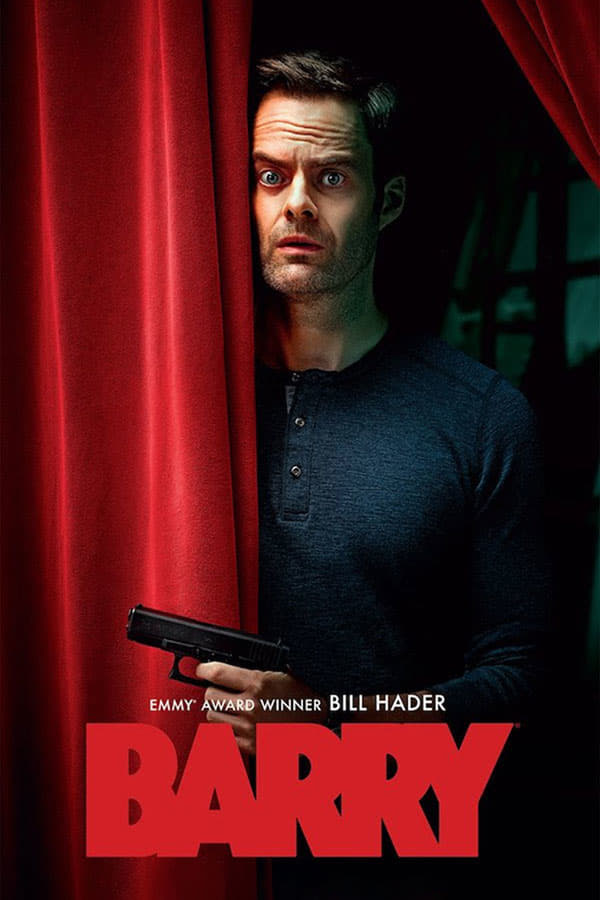
Hitman on A Hit Show: Barry Season 2 Review


As I’ve probably mentioned way too many times on this blog, there are so many series on the air that even the most devoted professional critic couldn’t cover them all. So when HBO’s Barry debuted last year to massive critical acclaim and big ratings, I was intrigued but chose to follow Billions instead. Part of my reluctance came because I had never been impressed by the work of Bill Hader before. He’d done superb work as an impressionist on SNL for almost a decade, but that doesn’t necessarily lead to great things. Then after the Emmys came out and Hader triumphed (as well as at almost ever other awards series in between), I realized I must at least give this series a chance. Having seen the first two episodes of Season 2, I now see that it’s nothing like I expected.
Hader plays Barry Berkman, a contract killer from Cleveland, who after coming to LA for a job, decides to try and take an acting class, and assumes a separate identity to do so. However, in order to cover his tracks, he continues to kill and in the course of just eight episodes, he racked up a body count Tony Soprano would envy, usually in connection with the Chechnian mobster. In the final episode, he ended up killing a detective who’d been tracking him all season, and who had become the girlfriend of the man running his class Gene Cousineau (Henry Winkler).
Barry (2018)
Barry seems to be trying to move on in Season 2. He’s taken up a job at a sporting goods store, and actually has a girlfriend Sally Reed (Sara Goldberg). But he still seems unable to juggle the two worlds. The mobster whose been protecting him from one of the murders he committed, now wants him to kill an Ecuadorian mob boss in order to protect himself. His former partner Monroe Fuchs (the always reliable Stephen Root) has retreated to Cleveland, but when his tooth was found at a quadruple homicide, he returns to LA, unaware that the police are following him. And Gene, though he seems to have recovered from the death of his girlfriend, is still clearly very damaged.
This series, frankly, plays more like one of the early Showtime dramedies that the network used to specialize in – Nurse Jackie or Weeds, and I mean this as a compliment. And a lot of the credit must go to Hader, who until I’ve seen these episodes, I didn’t think was remotely capable of plumbing such dramatic depths. There is something in Barry that really wants to be a different men, who doesn’t want to be a murderer. But the world seems to think that’s what he’s good in. When he asked the mobster: “Am I an evil person?”, the mobster doesn’t even hesitate before saying: “You’re the most evil person I know.:” And there are parts of it he just can’t admit to anyone: when he tries to tell the acting class of the first killings he ever committed as a soldier in Afghanistan, under Gene’s instructions, they act it out, and it plays as self-parody. But they can’t even consider the reality – that Barry felt nothing about killing the enemy. And when he tries to avoid going further, Gene more or less tells him he is not going to be able to hide from it. Hader does some of the best work as a bifurcated person I’ve seen since the days of Michael C. Hall as Dexter Morgan. Who would have thought Stefan was capable of such dark moods?
Strangely enough, most of the comedy works better around Hader than actually from him. Root, who is blissfully incompetent in his job as a criminal delivers some of the series best lines. And Goldberg, the Rita Bennett of this series, is equally impressive – the typical LA flake aspiring actress one moment, revealing her soul of being a battered woman the next. But by far, the most incredible work on this series comes from Henry Winkler as Gene. A man who truly does think that the world revolves around him (he seems to have tapes and diaries of every meeting he’s ever done), he is incapable of being sincere even when he earnestly he thinks he is.  A satire of every failed actor in Hollywood, Winkler has the ability to make this role his own, and in every scene, he more than demonstrates why he got the Emmy for Best Supporting Actor last year and should be in the conversation again this year.
But I think what makes Barry find its own muse in that it’s a tragedy in a way that so many series with antiheroes are not. Barry wants to be an actor, but he is still very capable of violence. The fact that the thought of Sally managed to keep him from acting last night doesn’t hide that fact. When will the cops catch up to him? When will Gene learn the truth about what Barry did? And what happens when he stops acting? There were a lot of critics who thought Barry should have stopped after his initial season – live fast, die young, and leave a good-looking corpse – or corpses. Just having seen the first two episodes of this season, that sounds like a terrible idea.  I think this series may end in the same wondrous darkness Breaking Bad did, and I can’t wait to see it unfold.
My score: 4.5 stars.

Thursday, April 4, 2019

Anything but a plain Jane: Jane The Virgin Farewell


Lost in the storm of publicity of Game of Thrones and Veep coming to the end of their runs in the next few months is the fact that two equally complicated but far more entertaining, human series are ending on the CW. There’s a certain logic to this – both series are finishing among the lowest rated on television – but one shouldn’t deny just how brilliant they’ve been. This Friday, we say goodbye to Crazy Ex-Girlfriend, and right now, Jane the Virgin is beginning its last season.
Jane the Virgin seems just as determined to go out, guns blazing. As those of us who have followed the series since the begin, one of the most painful moments in television history came when Jane’s husband Michael died from complications from a gunshot wound in the middle of Season 3. So in a series that’s been filled with more twists and turns than Shondaland, it really resonated when in the last moments of Season 4, we learned that Michael was still alive.
We’ve had almost a year to stew on this, and even wonder if this is Michael. (It should be remembered that one of the key plot points of this series was that there is a crime boss who operated a plastic surgery clinic). But apparently, this is Michael, and like almost every horrible event in this series, it was orchestrated by Sin Rostro, who kidnapped him, subjected him to repeated electroshock until his brain was damaged, and left him in Montana. (Only on this series could that actually be plausible).
So Michael’s back. Only he’s Jason now. And he’s kind of a douche. (It is a tribute to Brett Daier and the writers, who made us root for this character the first two years now turn him into a tool.) Which makes things extremely awkward for Jane and Rafael, who were just on the verge of getting married when Sin Rostro dropped this particular bomb. And now it seems that Jane and Michael are still married. Which is bad for Jane, because not only was she trying to finally find love and happiness again with her love/baby daddy Rafael, but now part of her still doesn’t want to give up on Michael. And it’s bad for Rafael, because Jason has apparently decided that he isn’t going to divorce Jane after all.
Jane the Virgin has been one of the most remarkable series on TV, mainly because (unlike Desperate Housewives did in its later seasons) it has never forgotten that it is a satire as well as an homage to the telenovela. The twists and turns of Jane and the entire Vilanueva clan have been as surreal as anything that happens at Wisteria Lane, but its never stopped being funny or grounded, because it doesn’t take itself seriously at all. (They acknowledge it in the opening titles, where they’ve been crossing out the word Virgin ever since Jane finally consummated her marriage). Indeed, right now one of the key storylines involves Jane’s father, Rogelio (the wonderful Jaime Camil) is finally realizing the American version of his own telenovela The Passions of Santos, with his arch-nemesis River Fields (Brooke Shields. Yes, they went there.) And its especially galling that Michael, the man he considered his best friend, now seems more attached to River than him. And, considering all they’ve been through, it did kind of hurt.
But, as good as everybody in the cast is, the star remains that force of nature Gina Rodriguez.  We’ve watched her go through so much in the course of this series, you wouldn’t think it would be possible for her to surprise us anymore. But in the season premiere, she delivered what was essentially a six-minute monologue where she dealt with all of the overwhelming issues that were coming up, all the while trying to convince her mother and grandmother that “she was perfectly fine”. On any other series in any other year, she’d be a shoo-in for an Emmy on that scene alone. Just like Rachel Bloom, she’ll be lucky if they give her a nomination.
Who will Jane finally end up with: Rafael or Michael? What is Sin Rostro really planning to get her lover Luisa back? And will we finally get an answer just who this wonderful narrator really is? They promise to answer these questions, and I trust the writers. Unlike so many other mythology series, they’ve yet to let us down. But more than that, I care about the answers – and whether Xo gets over her cancer, and whether Abuela finally finds happiness – because this is a show about fully dimensional people, even when they’re dealing with their evil twin sisters.
Jane the Virgin and Crazy Ex-Girlfriend are not like any other series on the CW. They don’t have superheroes or characters held over from the days it was the WB. But its hard to imagine any other network allowing them to exist (they seemed to get renewed almost casually every year along with every other show), much less allow them to come to the end of their run. For that, I am grateful to Greg Berlanti and his increasingly chaotic Arrow-verse, if their existence is what allowed these two extraordinary series to live all this time. Will any other great series like these emerge in their wake? It should be noted that a Jane the Virgin spinoff is in the works.
My score: 5 stars.

Wednesday, April 3, 2019

Has College Ruined Felicity Huffman Too


As I mentioned in an earlier article, I generally refrain from referring to scandal and criminal charges among celebrities unless I either am familiar with the creative forces or am personally stung by it. I was appalled by the recent crime saga involved the supposed attack on Jossie Smollett, but since I never watched Empire, I don’t really care one way or the other. I was upset when Jeffrey Tambor, a comedic and dramatic acting force was accused of sexual harassment on the set of Transparent, but because I was never clear on the details, I didn’t feel free to comment.
But when the news hit. that a group of celebrities were linked and, in some cases, being arrested, for being involved in bribery charges in order to get their children into colleges like USC, I think its safe to say that I was hit hard in a way that so many of the other scandals involving celebrities have not affected me. A lot of the publicity has surrounded Lori Loughlin, best known for playing Aunt Becky on Full House. But on a more personal level, I was hurt by the fact that one of my favorite actresses (and almost certainly her equally famous husband) are being charged and are facing trial. It really gutted me that Felicity Huffman and William H. Macy are involved in such corruption.
To explain why, it helps if one knows what their resumes have been, particularly on television. For the last few weeks, the media has delighted in playing a clip from Desperate Housewives where Huffman essentially bribes the head of a preschool to get her terrible children into it. But the fact is, Huffman’s character Lynette Scavio was always the most grounded and rational character on the hit series, and almost certainly the one who went through the most personal struggles. In the first season, she got addicted to her children’s Ritalin. She had a cancer diagnosis that pretty much affected her throughout the entire fourth season. She had a pregnancy with twins in season six that led to a miscarriage one of them. In a world that seemed to be forever bizarre, she was the most level-headed, and to me, the most appealing of all the characters.
Even though that was Huffman’s most famous role, her body of work on TV has one of the most consistently brilliant of the last twenty years. I’ve mentioned in various articles how impressive her work as Dana Whitaker on Sports Night was, and her versatility on the underwatched American Crime would have no doubt netted her as many Emmys as Regina King have we not been seeing a surplus of great female performances in limited series.
William H. Macy is, if anything, even more brilliant than his wife. I have noted in articles how fully repugnant I find Frank Gallagher to be on Shameless, but in a way, that’s a tribute to Macy’s chameleon like ability to take his affable personality and become someone this disgusting. It’s also worth noting that, prior to landing what is most famous role on television, he was known for playing Everyman characters. His most famous role in the 1990s was in the recurring role of Dr. David Morgenstern on ER (which brought him into contact with future Shameless creator John Wells) Morgenstern’s role was genuinely a rock of stability that other characters would lean on. When he was written off the series in Season 4, I begin to sense the long creative decline that would plague the series as they would begin to center around more and more unpleasant people.
He also did a series of exceptional TV movies for TNT, where he would show his versatility by playing characters completely opposite of his normal talkative self. His most awarded performance came for playing real-life cerebral palsy afflicted salesman Bill Porter in Door to Door in 2003. He would win Emmys for writing, directing and starring in it. Even more versatile was his work in The Wool Cap where he played a deaf-mute trying to help an unwed mother, which got him another Emmy nomination. (His work at TNT alone got him four acting nods)
And that only begins to cover his work in television. He is best remembered for his incredible work as the beleagured Jerry Lundengaard in Fargo, but he has been known for so many masterful character portrayals in the works of David Mamet, Paul Thomas Anderson, and almost every film you could imagine.
What I’ve always liked best about Huffman and Macy is that celebrity seemed to have touched them so little. They deal with the award shows and other events like the characters they play – asked to present at this year’s Emmys, they came in just saying ‘witty banter, witty banter.” Which makes the scandal that has involved them all the more devastating.
I think what I find hardest to take away from all this is: why? Huffman and Macy may not be superstars, but they are surely famous and multi-millionaires. Why on earth would they feel they had to bribe a go-between and falsify documents to get their kids into college at all? What does it say about the system of higher education that even the famous don’t feel secure unless they get involved in bribery and falsehood?
I also feel bad about who’s been charged. So far, Huffman has been pulled into court but Macy hasn’t. I don’t understand the proceedings here – Loughlin’s husband was charged as well – but I find it difficult to believe he is isn’t involved. This will do damage to their marriage, which has been one of the strongest in Hollywood until now.
There’s a lot to take away from all this, but there is one more thing that troubles me. Huffman was charged and hauled into court. Meanwhile, Louie C.K. is back doing standup. I’m not the kind of person that believes in moral equivalence, but surely C.K.’s crime was at least ad bad as Huffman’s, and he seems back to normal. I find this tremendously offensive.
All of this may come to nothing. The law, as we all know, doesn’t apply to the famous as does to everyone else. Lori Loughlin still has her job making movies at Hallmark, and there doesn’t seem to have been any move to fire Macy from the series he helped build. But it’s a stain on two of the last actors I really thought would ever be involved in a scandal, much less a criminal conspiracy. And it’s a blow that’s bigger than just seeing them pillories in the 24-hour news cycle.