Saturday, March 30, 2019

Deadwood Episode Guide: Mr. Wu


Written by Bryan McDonald
Directed by Daniel Minahan

By this point in the series, we have met the lion’s share of the characters. But in this episode we meet two of the most critical ones. As you can probably guess from the title, one is Mister Wu, the head of the celestials.
Technically, Wu has been here almost since the beginning of the series, but he seems most important for the fact that his pigs have been dining on most of the people who meet a messy end. (Considering the amount of murders we’ve seen just this season, it’s amazing that Wu’s pigs aren’t stuffed to the gills already.) But this is the first episode that we get the level of his importance. We know how low on the pecking order Chinese people were in 19th century America, so when Wu dares to walk in the front door of The Gem near the opening, Johnny is personally affronted. But now, we see that he has a certain level of connection with Swearengen, mainly in the level of opium, the drug of choice for so many in this series.
The scenes between Wu and Swearengen play out mostly as farce in practice. Wu spends most of the episode drawing everything that happens. He only seems to really know two words of English: “Swearengen!” and “Cocksucker!” (It is a tremendous tribute to the ability of Keone Young as to just how much he is able to express by his inflection of those words.) But it also speaks volumes as to how Swearengen deals with things that he makes the effort to try to comprehend Wu and his drawings, and never talks down to him the way that he does so many others in the camp. It helps matters that the problem Wu brings is critical to Swearengen. Two men have killed one of Wu’s couriers – a man who was supposed to bring opium to Wu and Swearengen – and have stolen his dope. Wu, understandably (pun not intended) wants the dope and vengeance. Swearengen knows that if he kills two white men, the camp will go to war with Wu and him, but he needs to keep his relationship with the celestial open. It doesn’t help matters the two killers are Jimmy, who we saw working for Al earlier this season, and Leon, Tolliver’s faro dealer.
The way Swearengen deals with this also shows a lot of how he views these miscreants as opposed to Wu/. When he brings Jimmy into his camp, he listens to the man’s story sympathetically, and then tells him the room “stinks of cat-piss”. This is how Al seems able to tell when someone is lying to him. He smashes Jimmy in the faces, and orders him to throw himself over the balcony. Jimmy doesn’t even hesitate to follow orders. Later, on when Leon joins Jimmy in the room, and tries to spin a similar story, he gets even more pisses, beats up Leon, who promptly vomits on the floor, and orders to Jimmy to clean the mess up. He then convinces Wu, very carefully, that he will give him ‘one dead thief’ but not two.
The other character that is new to the show arrives almost simultaneously. In the previous episode when Swearengen had his conversation with Clagget, the magistrate told him that there was a warrant out for his arrest, and it was going to cost him $5000 to get rid of it. The bagman, who comes to collect this, and the ‘right number for the legislature’ is Silas Adams.  When he enters the Gem to collect his money, he gives Swearengen a note from Clagget that essentially tells him that the payments are going to have to keep coming. Swearengen curses Silas and Silas curses right back. Something in Adams’ attitude clearly impresses Swearengen, and he tells him “pussy and whiskey are free” His attitude is reminiscent of Bullock’s, and it’s clear Al sees something special in this man.
Later in the episode, they have a conversation over whiskey in which Swearengen’s gets a clearer measure of Adams’ malleability. He clearly likes Clagget even less than Swearengen does, and doesn’t even blink at the idea of killing him. Swearengen then asks Adams to come with him to the bathhouse (when Silas hesitates, he jestingly says “No one’s looking to fuck you in the ass) and lays out the situation to Adams. It’s clearly an audition, and we can see Adams’ passes with flying colors – when he mentions Tolliver’s watching, Silas doesn’t do what almost anyone else would and look towards him, he asks the right questions when Swearengen asks about giving him one, and when he mentions Tolliver’s actions, he asks if Tolliver is looking for a fight, which is soon becomes clear he is.
The climax of the episode takes place when Al goes into the bathhouse where Leon and Jimmy are high as kites and soaking in tubs. He tells them both that they have to draw straws in order to see Wu to ‘apologize to him’. Leon’s level of high gives him arrogance, but Jimmy is clearly aware of the dangers, and doesn’t want to draw the straw. When he finally does, Swearengen drowns him, telling Leon ‘to tell his boss what he saw’. Silas doesn’t utter a word during the entire encounter, but when Swearengen’s mentions whether Tolliver’s message got across, Adams gives him his money back, asks why he killed his own man, and again gives the right answer as to what just happened and why. Swearengen is clearly impressed, and asks Silas to take off his hat, and tells him to get a haircut: “You look like your mother fucked a monkey”. Coming from Al Swearengen, it clearly means he sees value in this man.
So much of this episode surrounds Swearengen, Wu, and Adams that almost everything else gets thrown by the wayside. But there are two critical elements going on that do get attention. Bullock, having reluctantly taken on the office of camp refuse collector, is trying to make the camp a better place reluctantly, and even though Farnum clearly doesn’t see the point. It feeds to a certain level of irritation throughout the episode, and he finally expresses is to Sol close to the end, about his own problems, which basically come back to the fact that he’s sent for his wife and son, not so much because he thinks its time for them to come, but because he is fighting his attraction to Alma.
The other equally important point is the almost total degeneration of Reverend Smith, which plays out in multiple fields. In the last episode, Dan ordered a piano for the Gem, much to Al’s irritation. The music from the piano attracts the Reverend in this episode, and Swearengen, who is dealing with his problem, is clearly distressed, but even he has some reluctance to yell at a minister. Gently for him, he asks Smith to leave, and notes his ailments. However, Smith returns to the Gem two hours later, find the Reverend kicking up a holler, and disturbing all his clientele, and this time is far more belligerent when it comes to throwing him out. When he sees the Doc, who has come in to treat the whores, there is clearly something that borders on concern:

“You notice too how he’s starin’ cockeyed? He was in here two hours ago, don’t fuckin’ remember. (briefest beat as he reads Cochran’s expression) Nothing to be done, huh?
Cochran: “No”

He then covers by yelling at Cochran about Trixie’s wellbeing, but it’s clear that even Swearengen is not immune to this cruelty.
Indeed, Smith’s ailments have finally progressed to the point that his mind is going on him. Never is this made clearer in a beautiful scene where Smith returns that night to the hardware store where Seth and Sol are waiting. He remarks about how they bet, and how he looked after the goods, and after mentioning them, he says:

You are the absolute image of them, gentlemen. But what makes me afraid is that I do not recognize you as my friends.

Smith finally confronts the horrors of what is happening to him, and it is heartbreaking:

“I don’t know what’s happening to me. I have various ailments, and I suppose this is a further ailment, but of what sort I don’t know. I’m afraid if you are devils which –which I don’t believe you are because you were the kindest men of all in the camp to me. But if you were devils I suppose that – that would be the type of shape you would take and if you are not devils – then I am simply losing my mind. And with my other ailments I am concerned – and afraid.”

One can hardly do justice in mere words to the power of the performances. But Raymond McKinnon is absolutely astonishing throughout this scene. So much so that for the barest of moments we think Smith might be right – until of course, Seth and Sol gently play back the words that say in the pilot to him. “I’m from Etobicoke, Ontario”; “I’m from Vienna, Austria”. Smith truly realizes he is safe, and professes that the ailments are just temporary, and that “a night stroll with friends” might help him. But over the scene Swearengen’s simple phrase plays over it, and not even Smith’s comic mention that “Mr. Swearengen’s saloon has a lovely piano” can stop the chill that runs down our spine as we contemplate the inevitable.

Monday, March 25, 2019

Billions of Reasons To Watch Season 4


I have mentioned in my previous reviews of Showtime’s masterwork Billions how daring it has been of show runner Andrew Ross Sorkin to take two of the greatest actors working today – Paul Giamatti and Damian Lewis – put there characters in perpetual conflict, and yet have them rarely in the same scene together. So it is yet another daring master stroke in last season’s finale to put Lewis’ billionaire Bobby Axelrod and Giamatti’s cutthroat attorney Chuck Rhoades into forming an alliance.
Admittedly, circumstances for both of them have changed dramatically in that finale. Chuck’s attempts to bring down ruthless Attorney General Jock Jeffcoat led to his being fired as US Attorney for Wall Street when his former student Bryan Connerty (Toby Leonard Moore) and current student Kate Sacker (Condola Rashad) combined to betray him. An even deeper betrayal occurred at Axe Capital when Taylor (breakout star Asia Kate Dillon) jumped ship to form their own company, with the backing of Russian oligarch Grigor Andalov (John Malkovich, using his remarkable talent and charisma to get past the fact that he is woefully miscast).
It is a matter as to just how much the world of Billions has changed that in last night’s episode, Chuck walked into Bobby’s penthouse, got in asking for ‘Bob’, and told Axe straight out: “I don’t want you in my crosshairs anymore.”  It’s a bit much to say that they have gotten to the point that they are actually friendly, but we are reminded of an earlier statement by Wendy as to how much the two got along before Chuck started his rise to power. These two are clearly more alike then they are willing to admit, and this episode shows it. It also has given Giamatti more freedom as he has spent the last two episode operating as a lawyer who is trying to negotiate rather then search in destroy, and its actually wonderful to watch him.
Of course, Chuck has his eyes on his power. He “wants vengeance and it will be had” as he tells his father, and his plan is go after the state attorney general office.  When Connerty confronts him over this, he says: “I’m running and I will run over you like its Tiannemen Square.”
Axe’s problems are more complicated. Taylor is the most worthy adversary that Bobby has ever faced, and no doubt he feels the betrayal more harshly because they served as a willing pupil for the first time. And in the season premiere, his attempt to earn key investment from the Middle East ended up with Wags being held prisoner and him learning that he had been outmaneuvered by Gregor. Bobby found himself confessing: “I’m overmatched for the first time since I can remember.” And Taylor seems able to manipulate Gregor in ways that Bobby can’t. After Bobby closed all the banks to him, they managed to outmaneuver an attempt for the Russian to get more power and Bobby by using him to do it. Gregor actually seems to admire them in a way that he never did Axe, and its clear that Taylor despite not wanting to play dirty has learned from the feet of the master.
 If there is a flaw in this season so far, its that the female cast has been weaker than usual. Malin Ackerman is no longer a regular and Condola Rashad, whose political ambitions were a far crueler blow than Jason’s vengeance, has had practically nothing to do so far this year. There are, however, still some promising additions, led by Nina Arianda as a woman billionaire who may just be Bobby’s soulmate financially and sexually. And as always, Maggie Siff continues to be the strongest force as Wendy, who finds that the war against Taylor is starting to drain her in ways she’s never felt before.
Billions remains one of the best series on television in its ambition, power dynamics and dark humor. The fact that it has not even been nominated for any Emmys up to this point in its run is nearly as appalling as the fact that The Good Fight has been similarly deprived. There are going to be a lot of vacancies in the Best Drama category this year with so many HBO and Netflix contenders out of play. This is one of the series that deserves recognition, as it reminds you just how good television can be.
My score: 4.75 stars.

Saturday, March 23, 2019

Deadwood Episode Guide: No Other Sons or Daughters


Written by George Putnam
Directed by Ed Bianchi

“My joint. Two hours. We’re forming a government.”
Deadwood by far takes place in one of the bleakest settings of all the dramas that would bring forth the new Golden Age of television  - yes, even darker than the Jersey of The Sopranos and the Baltimore of The Wire. But there’s a very solid argument to be made that it’s also the most optimistic of the three series that launched that age and HBO. At their core, both The Sopranos and The Wire are about how people react to the death of the American dream, either by responding to their basest impulses or because they are stuck in a web that they cannot escape. Deadwood is, in stark contrast, about the beginning of the American dream, and as this episode demonstrates, is about disparate people, many of whom we’ve already seen are malodorous, if not downright evil, coming together for a common goal.
It is no coincidence that Swearengen is the man who is responsible for starting what amounts to the ‘ad hoc government’ that will effectively run Deadwood for the remainder of the series. Swearengen may be bloodthirsty, and he may only care for his own well-being, but he has already demonstrated long-term vision that several of his companions clearly lack. He may hate Magistrate Clagget with a passion, but he listens to what he has to see about the possibility of annexation, asks the clearest questions about it, “What’s the right number for the legislature?”, and goes through the entire camp getting every single person he thinks might be important, including several he has actively at odds with.
And several members of the camp are willing to step up. Charlie Utter, who up until this point has had no interaction with Swearengen, shows up at the Gem, and despite just having started a very important new business, volunteers to be fire marshal. Doc Cochran is willing to volunteer his duties in the health department. Bullock, who openly admits to Sol when the meeting is over that he didn’t want to burden, volunteers to a key office, if only because he doesn’t want to be sheriff. And of course that bastion of integrity, E.B. Farnum basically volunteers to become Mayor, because no one else wants the job. Even if he only wanted the trappings of power, Farnum clearly has an idea as to how government works: “taking people’s money is what making organizations real”, which is a cynical but realistic picture of how government works. Much of it is symbolic, like the peaches and pears that Johnny ladles out at intervals throughout the meeting, but symbols are important.
Swearengen seems a lot more human in this episode than we’ve seen so far. From the opening where he casually lectures Trixie on what he’s thinking about life after the annexation, to when he reluctantly gives Johnny Persimmon Phil’s old position (and cheerfully admits to Dan that he had to flee his own office in terror) to when he goes through the entire camp basically talking to everybody, including Bullock and Starr about what’s needs to happen next. (He even manages to compliment them on now nice their newly build hardware store looks.) And it clearly takes a lot out of him; when it’s all over, he freely admits all the conviviality gave him a damn headache.
Others are not nearly as willing to become part of the whole. Tolliver agrees to come to the meeting, and is willing to bring Eddie, who in his own way is clearly in as much as Joanie is about the murders he committed in the previous episode. He’s told Joanie that he’s willing to front her money to open her own brothel, but we know just by looking at him, it was something to say. Eddie asks to come to the meeting of the elders, but when he asks a question that pertains directly to Joanie, Cy can’t let it go when the meetings over, and has an angry conversation where he all but calls Eddie a pedophile (we never learn one way or the other about Eddie’s sexuality). He’s just as cold to Joanie when she makes her own suggestions about getting out, and its very clear that he is now pretty close to destroying ‘the family’ that he has spent years building.
A sadder example is that of Jane. She’s managed to hold it together while serving as a nurse at the plague tent the last couple of episodes, but in this one, she goes on what for any other character would be an epic binge, but for Jane is basically Monday. Both Cochran and Charlie are well aware of just how bad it is, and try to offer ways for her to come out of it. But in a rare moment of self-awareness, Jane says that she can’t stay sober and is tired of embarrassing herself near the body of Bill. At the end of the episode she rides off. It is not clear whether Milch and the rest were genuinely considering writing Jane out of the series (though she remains in the opening credits, Robin Weigert does not return for the remainder of Season 1), but it is clear that Jane will never be a part of the camps as a body.
And by far the most tragic case of someone who is not long for the camp – or indeed, for this world - is Reverend Smith. We’ve known he has been in bad shape for weeks, but now it is clear even to him that something is horribly wrong. He apologizes to Jane for his order, claiming he smells of rotting flesh. His eyes are fixed, and he can’t use one of his arms. But worst of all, he says that he can no longer feel “Christ’s love”. He is still trying to convince himself that his suffering is somehow part of God’s purpose, even if he doesn’t understand what that purpose is. Cochran, who though he will not say so directly for another episode, knows exactly what is killing Smith, and says, with perhaps a greater cynicism that if this is His purpose, “God is a real son-of-a-bitch”
If the greater theme of this episode is about forming a government, the rest is about former relationship, and in three scenes we see the beginnings of bonds of three critical ones to Deadwood.  The first is that of Joanie and Charlie. Joanie is going through the camp, ostensibly looking for a place of her own. Her path, however, takes her down the darkest sections, including that of the Chinese, where Wu’s pigs are dining on the remains of Flora.  At the moment when she is the most vulnerable, she runs into Charlie, who is a wearing a new suit for his business, and is feeling foolish. The conversation they have is very simple – they introduce themselves, they talk about their jobs, Joanie freely admits she’s a whore, and Charlie doesn’t seem to judge that. It’s never directly spelled out – Milch is remarkably subtle in that sense – but Charlie may be the first man who Joanie has ever met who doesn’t want anything other than simple friendship. Their relationship will be one of the smaller joys of the series.
The second relationship involves Trixie and Sol. A couple of episode backs, Sol openly invited Trixie to his hardware store to simply work on sums, and its been clear ever since that he is sweet on her in a way that goes outside the relationship of prostitute-client. In a way, Sol is as much an outsider in this camp as Trixie is, and while he will be given more deference than her, he will not be respected. When he goes into the Gem, and strikes up a conversation with her, it clearly surprises Trixie as to how happy it makes her. She covers it up in a way, but it’s apparent to Swearengen who knows how to read her perhaps better than she knows to herself.
The third – and by far the most crucial to the series – is that of Alma and Seth. They have been trying to keep it professional up until now – Seth says that he wants to talk to her about Ellsworth about how to best mine what is clearly a hell of a gold claim – but almost from the start, there has clearly been a sexual undercurrent. Seth clearly knows this, and almost casually mentions to Sol that it’s time to send for his wife and son. Near the end of the episode, when he and Alma are having their final conversation, he makes a special point of mentioning that he is married. But having done so, he then makes it clear that his wife is his brother’s widow, and that after he died in a cavalry charge, he married her more out of duty than love. In the 1870s, even in a camp with no law like this one, it is clear that the social etiquette remains absolute here. But it’s becoming increasingly clear that Alma married Brom under much the same reasons that Seth married his wife. And as much as they are trying to stay firm to those rules, it becomes increasingly clear with each conversation they have that both of them want to cast those rules aside, and damn the consequences. They almost seem relieved when they awkwardly bid each other goodbye at the end.
And its own way, it’s clear that Bullock is trying to hold fast to at least one set of responsibilities. He knows this town needs a sheriff, and he doesn’t want to be that man, even if he is the most qualified. He is clearly attracted to Alma, so he sends for his wife and son. The pull between Bullock’s desires and greater responsibilities are at the center of Deadwood, and in a way, they’re almost as important as forming a government.

Wednesday, March 20, 2019

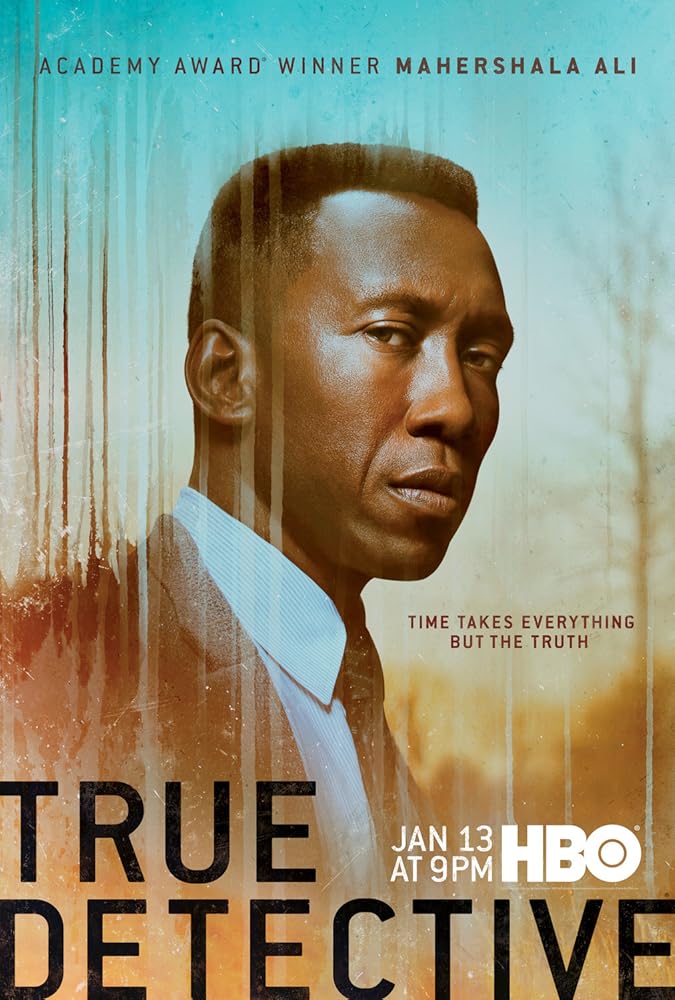
A True Return to Form: True Detective Season 3 Evaluation


Due to several unforeseen events, most notably the Academy Award, I didn’t get to finish the third installation of True Detective until a few days ago. And unlike the previous installments, I actually gave a damn about how they wrapped it up this time.
When True Detective premiered in 2014, I got the feeling that Matthew McCounaghey received the Academy Award in part of because of his searing work at the center of Season 1. The fact that he didn’t go on to win an Emmy that year was mainly due to the misguided notion of the producers to nominate the series as a Drama as opposed to a mini-series. (Then again, he might very well have lost to Billy Bob Thornton or Benedict Cumberbatch; it was a strong field that year.) I suspected that there might have been a similar carry over effect for Mahershala Ali who was at the center of this year’s installment, and ended up winning for Green Book (ironically, on the same day that he triumphed the current installation wrapped up). I think there is an excellent chance that this year, Ali’s work will almost certainly be recognized as Best Actor in a Limited Series, even though the competition will probably be just as strong.
One can’t deny, however, that Ali’s work in Season 3 almost certainly held the story together. One can also admit that Wayne ‘Purple’ Hays was a far more compelling character than we’ve had on TV in awhile. In part, this is because the series tried something that actually was more ambitious then last time – trying to hold together a single narrative over three distinct periods: the original crime in 1980, the new task force in 1990, and Hays revisiting the case a final time in 2015.  Unlike previous installments, it actually acknowledged the faulty narrative by having an unreliable narrator – as Hays tried to figure out the solution, his memory was starting to fall apart through some kind of dementia. Ali’s performance was honestly one of the best that he’s giving in any medium, and reminded us why he has, in the space of just six years, become one of the greatest and most versatile actors working today.
But in all candor, I think that there’s an argument that the third season was the finest work that True Detective has done so far. Unlike the first season, which featured two extraordinary lead performances, the central mystery was so tangled that its eventual solution came as a distinct anticlimax. And the second season was so bogged down that its not worth repeating its numerous flaws. In contrast, the third season center around a single mystery – what happened to a missing girl in 1980, and how the investigation went horribly wrong, and got destroyed by a corrupt system. And while there was a cover-up, it was not at the heart of the real story. There was one man who was responsible for the cycle of events that happened, but unlike the previous installments, we actually got an explanation for the crime at the center of the story, what happened to Julie Purcell in the second investigation, and what might have happened to her in the third.
What made this work better than usual is that, for the first time in True Detective’s brief but messy history, we also got a happy ending. Wayne Hays managed to figure what probably happened to Julie after the horrors of her kidnapping, imprisonment and escape, and somehow that she managed to find a happy ending. That Wayne managed to learn the truth, but that his memory betrayed him at the end was a pang that real stung in a series that has so often favored style over substance.
Unlike the first season, where the parts seemed greater than the whole, almost everything involving the third season seemed to resonate and work in a way that the others didn’t. It had the first truly strong female character – Carmen Ajojo’s work as Amelia, the schoolteacher of the Purcell’s who eventually becomes Wayne’s wife, and builds her career around the story of the investigation, and it was a truly human relationship, compared to all the ones we’ve had so far. And though Ali was extraordinary, attention should be paid to Stephen Dorff for his work as Roland West, the detective who agrees to bend after Wayne is demoted, who tries to help him years later only to destroy himself after a horrible mistake, and who manages to rebuild his life a quarter-century later. This may have been the first equal friendship we’ve seen in the series, and I hope attention is paid to Dorff at award seasons this year.
And what’s next for True Detective? I’m honestly not sure. Our expectations were so high after Season 1, and were very quickly cruelly and horrendously dashed. It took Nic Polazzo nearly three years just to come up with an installment that managed to erase the memories of Season 2, and almost bring it pack to par with the original. For all Polazzo’s gifts – and as was demonstrated thoroughly throughout this season, they are considerable – he’s still having trouble coming up with a consistent and arresting narrative. And he really needs to work on making his female characters stronger – Amelia is the first really dimensional one he’s managed to come up with in three seasons, which isn’t encouraging. Maybe the lesson is, he needs to take time between seasons. Let the juices marinate. Concentrate less on philosophy and more on coherency.
Will it ever be a true measure of greatness for HBO? I still can’t say with certainty. What I do know is that in a season that has already featured some great limited series (Sharp Objects, Escape at Dannemora) and will likely have some more before its through (Fosse/Verdon, Good Omens), True Detective has finally managed to elevate itself back into Emmy conversation again. That’s probably enough for now. We’ll save the rest for another ‘flat circle’.
My score: 4.75 stars.


Saturday, March 16, 2019

Deadwood Episode Guide: Suffer The Little Children

Written by Elizabeth Sarnoff
Directed by Daniel Minahan

It’s rare in any medium that you get to see a superstar born. But that’s what happens in this episode when you watch Kristen Bell. This episode takes place mere hours after the events in the previous one, and in her scenes as Flora, she completely dominates and elevates the performances of an already impressive cast.
Flora returns to the Bella Union, apparently shaken by the murder that took place when Dan ‘defended her honor’. She manages to convince Joanie so thoroughly in her scene that it’s becoming increasingly clear that Joanie, who has been tasked in turning her out, has begun to be seduced by her instead. Rather than try and sleep with her, she just holds her the entire night. The next morning, when Flora comes out of the room, Joanie actually tries to convince Cy that she needs to be protected. But Tolliver, who has clearly been around the block, is not fooled for a second. Flora then goes into the other whores’ room, and offers two dollars for food. When one of them offers to sell her a knife, she goes: “I got a fucking knife.” And in the next few moments, when one of her tricks comes to see her, she threatens so calmly, you realize she’s done this dozens of times before.
It is an astonishing performance, and is rather ironic that Bell’s charisma worked against Deadwood. Originally, Flora and Miles story had been to play out until the end of the season. However, Bell got cast in Veronica Mars, the work that has become even now, her signature role. The story had to be resolved quicker, and as you’d expect, it ends badly for the brother-sister team. I’m betting, however, that none of the viewers thought it would end this badly.
Flora is smart enough to know that Tolliver is on to her, but her daring makes her decide to rob the Bella Union anyway. She and Miles make an elaborate con of quitting their job, but when Flora goes up to steal from Joanie, things degenerate incredibly fast. The moment Joanie catches Flora, she tells her point blank: “You’re not leaving here alive.” Flora makes a try for it anyway, but Tolliver has caught on, and is determined to make an example of her and Miles. As they try to escape, he sends two thugs into the street to beat them senseless. Even in a town with no law, this gets the attention of the thoroughfare. At this point, we know Swearengen would never do something like this is in public, which may be the key difference between him and Tolliver.
But even after they’ve been beaten to the point of death, the true horror occurs in the next scene. Tolliver calls Joanie and Eddie into the room, where the dying thieves sit. Not content with merely executing them, Tolliver berates them verbally, saving his worse taunts for Miles:

Don’t be fucking passing out youngster. Next tucking breath you draw the smell of fucking sulfur’s liable to be strong in your nose. WHERE IS YOUR FUCKING NOSE, ANYWAY? Fuck it, Miles! Your found guilty of being a cunt. I’m hereby passing judgment for you letting this little bitch push you around and telling you what to do. When you were supposed to be a man and showing her the fucking rules!

He then shoots him. He then berates Flora, who even brain damaged is still trying to grab the gun from him. And then, he tells Joanie to kill Flora herself. She does, and in one of the most heartbreaking moments of the series, she follows by putting the gun under her own chin.
In many ways, this moment of cruelty is Powers Boothe’s finest hour on the series. His next scene is also incredibly powerful in which he goes to Joanie and comes as close as he will ever come on this series to apologizing for his actions, as well as to saying that he loves her. However, it is too late for this part, as Joanie tells him bluntly: “Either kill me or let me go.” Kim Dickens gives her first extraordinary performance on this series. From her inner tenderness for Flora, to her trying to defend her to Cy right up until he kills her, she reveals a prostitute who is far more damaged than any of the worse looking ones at the Gem.
 This series of events is so brilliant that almost makes you forget the larger stories that are still going on. For one thing, the episode opens with Farnum confronting Swearengen in a rare act of bravery, saying that they should murder Alma and Bullock in their sleep so that they can get a hold of the gold claim. Moments later, however, the riders come in firing off guns, bringing with them the vaccine, and even more importantly word that the Indians have signed a treaty and that annexation from the United States seems sure to come. At that moment, Swearengen reveals once again his ability for foresight.  He knows that they are about to be knee-deep in money, and as much as Bullock rubs him the wrong way, he thinks that he can be the perfect front man for the camp with the government. Therefore, as much as he wants the gold claim, he decides to be patient and withhold action.
At the same time, it is clear he has other things on his mind, mostly what has happened to Trixie. He has a frustrated conversation with Jewel, the cripple who sweeps up for him at the Gem, and who despite her simple nature can give as good as she gets, about the whereabouts of Trixie who never came back after the last scene of the episode. He sends Johnny to try and find her, but he has no luck, because Trixie has gone to Doc’s and tried to kill herself with the same laudanum that she worked so hard to free Alma from the last three episodes.  
Brad Dourif delivers a great performance when he discovers Trixie. He tries to encourage her to live again, and find a way to take Alma’s offer to go to New York to look after the child. He also has two superb scenes with Alma, once where he is grateful that she has decided to leave the camp, and once when he tries to persuade about the legitimacy of her offer. It is becoming increasingly clear that he is the conscience of a place that probably denies it has one and the look on his face at the end of the episode when he sees a recovered Trixie slowly walking back to the Gem expresses more than any of Milch’s words.
In this episode, we finally get resolution involving the Garrett claim, which ties up a couple of other storylines. Dan takes Bullock to Ellsworth to assay the claim, and Ellsworth takes the opportunity to thank Dan for not telling Swearengen. They find the gold formation, and Seth finally tells Alma not to sell. With a genuine reason to stay, she now does so (and does so in such a way to put the knife in E.B.’s gut – metaphorically). She finally goes to Trixie, who is recovering from her overdose, and it is to her the Metz girl finally says her first word: “Trixie” Moments later, she officially calls herself Sofia, and its one of the most heartbreaking scenes in the series that this is where we have the breakthrough for the child.
Bullock returns to the Gem and tells Swearengen what has transpired. They have their first truly civil conversation in the series, in which Swearengen puts forth that because of the annexation, it would be best “if they got their boats rowing in the same direction” Bullock is agreeable, as long as the saloonkeeper stays away from Alma. He agrees to, and Bullock actually stops for a shave in the Gem. This movement pretty much sets up détente between the two opposing forces; they’ll have some notable disagreements throughout the show, but from this point on, Al and Bullock will find it  in their interest to work together.
By the way, after Miles and Flora are murdered and disposed of, we find that it is clear that Al was on to what was going on the whole time. When Dan tries to apologize, it becomes obvious, as Al puts it, “that Dan’s dick blinded him”. He probably could have handled it himself had he not been so concerned with bigger issues. Instead, he simply shrugs it off, and asks Johnny to find out what Tolliver paid for disposing of the bodies.
However, the focus on this episode has been all about the two prostitutes. Joanie has decided to try and find a way to break free of Cy in this episode, while Trixie appears to decide to go back to Al.  However, we can definitely tell that are signs that the two will reverse course. Joanie will never quite recover from the seduction and murder of Flora. In the meantime, when Trixie enters the Gem, she looks at the bloodstain that Jewel and Al have been trying with no success to get rid of all episode along, and she just seems more pissed that Jewel is “on her knees at two in the morning” Then she tells the night man to wakes up, and goes into Al’s room. In a mirror of the last scene of the Pilot, she gives him the gold that Alma gave her when she visited, he slaps her, and she undresses and gets into bed with him. Al clearly has respect for Trixie and cares for her in the same way Cy does for Joanie. But he will be able to do what Cy never can: let her go.

Friday, March 15, 2019

Gasp! A Shondaland Show For The People. Yes, Really


As anyone who pays even remote attention to my column knows, I utterly loathe almost everything Shonda Rhimes is attached to. Which is why I was so surprised – delightfully so, in fact – that the most recent Shondaland series, For The People, is such a delightful tonic. There have been legal-based dramas in the Shonda-verse before, but this one takes place in a world so far removed from How to Get Away with Murder that it might as well be in an alternate universe.
The courtroom drama, once a staple of network television, has all but died out, with even standard bearer Dick Wolf all but vacating the field. So the fact that there is not only one on network television, but one that actually tries to appeal to the better angels of our nature, is something that television, in all it forms, desperately needs. Set in one of the New York District Courts, the series focuses equal time on both the prosecutors, led by Roger Gunn (Ben Shenkman), and the public defenders office., led by Jill Carlan (the always great Hope Davis. This being Shondaland, Carlan and Gunn are now in a romantic relationship, but its been a remarkably chaste one that both characters spent most of Season 1 denying. The prosecutors and defense attorney are, as per Shondaland, young and diverse. There’s Leonard Knox, the arrogant motivated African-American who cares all about winning. There’s Jay Simmons, the Jewish defense attorney, who still lives with his parents. There’s Sandra Bell (Britt Robertson), the foster child who plays a defense attorney with her ideals intact. And there’s Kate Littlejohn (breakout star Susannah Flood) the seemingly mechanical prosecutor, who may be the smartest person in the room.
And what may be the hardest thing to believe about For the People is how little the characters seem to care about sex. There were maybe half a dozen sex scene in the entire first season of the show, which for a Shondaland series is tantamount to wearing a chastity belt. There have been none in the first two episodes of Season 2, which is even more remarkable. The characters are attracted to each other – that’s nothing new – but they seem to care about their careers first, justice second, and then their love lives. In Scandal and Murder, justice wouldn’t even make the top five.  Which means that the series is actually about – gasp –  the law, and those who try to abuse it. In an absolutely brilliant story last night, Kate basically spent the entire episode trying to convict a shady defense attorney of conspiring to murder his wife. She knew all the legal pieces that he had done, but couldn’t use the law to crack it. It was when she tried to break him on such a basic level of humanity – how everybody handles personal email – that she managed to beat him. This is superb work, and I really think Flood should be in the consideration for an Emmy.
But by far the most appealing and relevant story came last night, when Tina Krissman (the always astonishing Anna Deveare Smith) found herself taking care of the son of a witness who had been called in to testify in a trial and was picked up by the government as an illegal immigrant. She spent the entire episode trying to protect the boy, and what happened unified the entire courthouse in a way that would’ve done Aaron Sorkin proud.  There was a confrontation in the courthouse halls between ICE and Tina that unified the entire court, and demonstrated the arrogance of ICE, when they told a district judge that he had no authority.  There was the utter futility of a defense attorney trying to get through a credible threat hearing in Arizona and getting nowhere. There was a scene between Jay and Tina about what America was, what it is, and what it could be. And there was a solution where Leonard Knox – traditionally the most ruthless person in the room – was all but reduced to tears when he tried to come up with a way to save him. I’m not saying the ending was necessarily realistic, but the optimism and humanity in the writing and performances – especially from Smith – had a teeth and idealism to them that has been missing from any network drama about the law in a long, long time.
Earlier this year, TGIT did the world a huge service by putting A Million Little Things – a good series with no Shondaland connections – after Grey’s Anatomy. Its ratings doubled and it was renewed for a second season. I’m really hoping that the same kind of bump occurs for For the People. Right now, its ratings are on the same level as How to Get Away with Murder, but this is the series that needs to be binged and adored. It’s not just one of the best courtroom dramas on TV; its one of the best shows on network TV period. And considering the source, you know what it takes for me to say that.
My score: 4.75 stars.

Wednesday, March 13, 2019

Celebrating Alex Trebek


I rarely try to keep my voice from entering these columns, mainly because I wish to remain professional in my criticism. But an announcement last week that it is fair to say stunned the world has made me feel that I must, for a change add my own commentary.
As the rest of the world knows, Jeopardy host Alex Trebek announced last Wednesday that he is suffering from stage 4 Pancreatic Cancer. This is not the first ailment that the beloved emcee has suffered – he tore a rotator cuff in 2010 and suffered a heart attack in 2015, yet managed to stay so faithful to the demanding shooting schedule of his series that I, along with countless other viewers, only learned about it after the fact. But despite the bravado of Trebek, and his own determination to beat the odds, I think it’s fair to say the chances of him surviving this disease are not that good.
This is a devastating blow to me in a way I can’t hardly put into words. I have been watching Jeopardy for as long as I can remember, and have been playing along at home for almost as long. I’ve managed to muddle through the loss of other great actors and actresses, but Alex Trebek has been coming into my home for so long, it’s hardly an exaggeration that I consider him part of the family. And I have no doubt that there are millions of people who feel the same way.  Jeopardy and all its accoutrements have been coming into our homes for so long that everything about it – the Daily Doubles, the ‘think music’; categories like Potent Potables and Potpourri have in their own way become part of our lives. Even the spoofs of Celebrity Jeopardy on SNL – which, if anything, give the celebrities too much credit – have been treated with just amusement that the writers have turned the satirical categories into genuine ones.
Trebek has been associated with Jeopardy for so long, it is actually rather shocking to know that the series once existed without him, and he without the series. Jeopardy was a 1960s and 1970s series, played for much lower stakes on morning TV, by pioneering Game Show host Art Fleming. And Trebek didn’t even get his start on Jeopardy – he originally got started on a far more gimmicky game show called High Rollers. (They made a reference to it a few years back, and he was actually miffed that none of the contestants recognized the show.) And if he wasn’t busy enough in the late 90s, he also did double duty in the remake of Classic Concentration, the card matching, rebus solving came.
I think it’s fair to say that few game show hosts in history have had more work to do than Trebek does on Jeopardy. He has to keep track of which of thirty clues a round have been picked, which are still available, be careful not give anything away in the reading (in my quarter-century of watching, I think he’s messed up less than a dozen times total), keep charge of the scores, and do so with an inflection that Conan O’Brien has parodied to perfection over the years. He has gravitas, something that has gone out of style for game show hosts – and indeed for most people on TV – and has always had the good sense that when it comes to Jeopardy, his job is to not take any attention away from the contestants. He probably has more work to do of any TV show host in history, and he’s already set a record for having done it for longer than anybody else.
It’s hard to imagine Jeopardy without Alex Trebek, though even before his diagnosis, there were signs that it might happen just as a matter of the passage of time. Trebek is 78, and his contract was scheduled to run out in 2020. He renewed it late last year until the 2021-2022 seasons. Even then, there were discussion of who might one day have to succeed Trebek, and while he made suggestions, some serious, some whimsical, and even though other people, including Jeff Probst have hosted other forms of the series, its very hard to imagine anyone doing with even a scintilla of the class and distinction that he has done for so long.
Jeopardy has always had a special place in my heart. Every year for the past decade, I set aside time to replay three of their ultra tournaments that have occurred in the past century that I had the good sense to record in one form or another over the years – the Million Dollar Masters in 2002, the Ultimate Tournament of Champions in 2005, and the Battle of the Decades in 2014. Earlier this year, I intended to add to this the Jeopardy All Star Challenge.  I shall continue to watch them as I have, but I think now they will have a certain level of poignancy now that there is a very good chance they will be among the last tournaments that Trebek will ever host. I will hope for the best – I have no doubt that he has the hopes and prayers of millions – but I know that when it comes to what has made this series last so well, the answer will always be… Who is Alex Trebek?